PEST MAGIC / MIDDLE GEORGIA
Why Cockroaches Come Inside in Late Summer
Seeing roaches inside your Georgia home? Learn why they come indoors, which species may be present, what to avoid, and when to call Pest Magic.
By Trevor Barnett · August 22, 2026
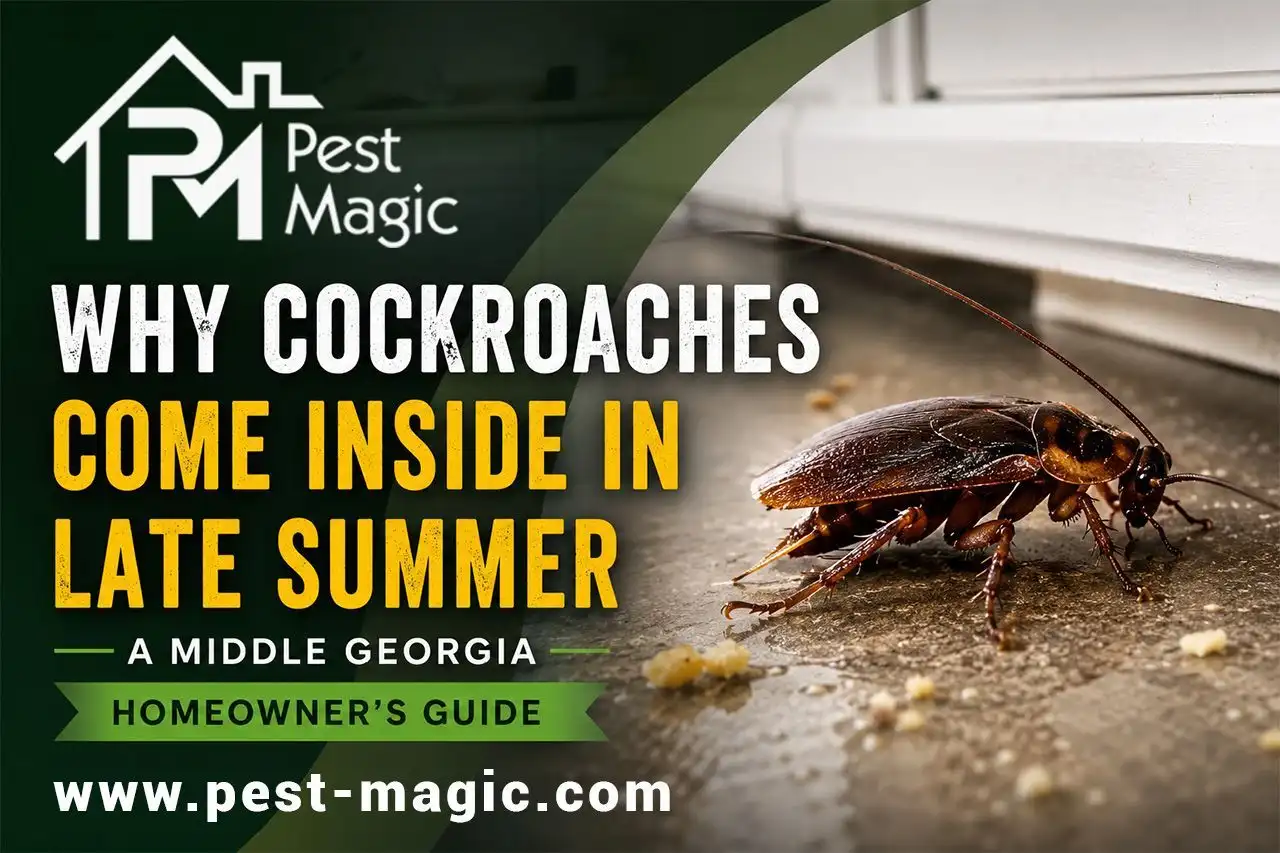
Flip on the kitchen light after dark and see something race beneath the refrigerator? Find a large roach near the back door after an afternoon storm? Late summer is a common time for Middle Georgia homeowners to notice cockroach activity—but not every roach points to the same problem.
Georgia has several cockroach species that may turn up around homes. Some usually live outdoors and occasionally wander inside. Others, especially German cockroaches, are indoor pests that can establish themselves around kitchens, bathrooms, appliances, and other warm areas with access to food and water.
The quick takeaway: One large roach near an exterior door does not automatically mean your home is infested. Repeated sightings of small tan roaches, young roaches, or egg cases around a kitchen or bathroom deserve faster attention.
Why Cockroaches Show Up Around Homes in Late Summer
Middle Georgia’s heat, humidity, mature trees, mulch, leaf litter, crawlspaces, sheds, and shaded landscaping provide plenty of places for outdoor cockroaches to find moisture and shelter. Many of these insects are active at night, which is why homeowners often discover them after turning on a porch, garage, bathroom, or kitchen light.
Heavy rain and saturated ground can disturb outdoor hiding places. Cockroaches may move toward foundations, porches, garages, attics, crawlspaces, and other protected areas while searching for shelter.
Entry does not require a wide-open door. Worn door sweeps, gaps around plumbing and utility lines, damaged screens, siding gaps, vents, and openings around the roofline can give outdoor species a path inside. Cardboard boxes, used appliances, stored items, grocery packaging, and deliveries may also carry cockroaches or egg cases into a building.
Once indoors, food crumbs, grease, pet food, trash, condensation, leaking plumbing, and clutter can help a small problem become much harder to control.
Four Common Cockroaches You May See in Georgia
Correct identification matters because the right response depends on whether the cockroach normally lives outdoors or is breeding inside the home. Size, coloring, markings, location, and behavior can all provide useful clues.
Use the photo guide below to compare four cockroaches commonly encountered around Georgia homes.
Smokybrown Cockroach
A large, uniformly dark reddish-brown cockroach commonly found around mature trees, attics, crawlspaces, sheds, and other humid hiding places.
American Cockroach
A large chestnut-brown cockroach with a pale marking behind the head, commonly associated with sewers, basements, utility areas, and other dark, damp locations.
German Cockroach
A small tan indoor cockroach with two dark parallel stripes behind its head, often found near warm kitchen appliances, cabinets, sinks, and water sources.
Asian Cockroach
A small tan outdoor cockroach that resembles the German cockroach but readily flies and is commonly found in mulch, leaf litter, shaded vegetation, and high grass.
What about “palmetto bugs”? Palmetto bug is a casual name often used for several large cockroach species. It is not a separate scientific species, so a clear photo or specimen may be needed for accurate identification.
Does Seeing One Cockroach Mean You Have an Infestation?
Not always. A single large smokybrown or American cockroach may have entered from outdoors, especially when it appears near a garage, door, crawlspace, attic, or utility area. The pattern of activity is usually more important than one isolated sighting.
The following signs make an established indoor problem more likely:
Roaches continue appearing over several nights or in more than one room.
Several small roaches are found around sinks, cabinets, refrigerators, stoves, or dishwashers.
Different-sized roaches or very small nymphs suggest that reproduction may be occurring nearby.
Capsule-shaped egg cases are discovered behind appliances, inside cabinets, in boxes, or near hidden cracks.
Dark specks or smears repeatedly appear along cabinet corners, appliance edges, drawers, or other hiding places.
Sticky traps placed along walls repeatedly collect roaches in the same area.
Cockroach droppings, shed skins, and body particles can contribute to indoor allergens and may trigger allergy or asthma symptoms in sensitive individuals. A persistent infestation deserves attention, especially in a home where someone already has asthma or respiratory sensitivities.
Why Roaches Can Appear Even in a Clean Home
Cockroach activity is not always a sign that a home is dirty. Outdoor species may enter through structural gaps, while indoor species can arrive in boxes, bags, used appliances, furniture, or items brought home from storage.
Roaches also need much less food and water than most people realize. A slow plumbing leak, condensation beneath an appliance, crumbs beneath a stove, grease beside a cabinet, an open pet-food bag, or water left in a pet bowl overnight may be enough to support activity.
In apartments, duplexes, offices, restaurants, and other connected buildings, cockroaches may also move through shared walls, plumbing openings, utility chases, and neighboring spaces. Cleaning helps, but sanitation alone may not address the original source.
Seven Ways to Make Your Home Less Inviting to Roaches
Use Sticky Traps to Find the Activity
Sticky traps can help determine where roaches are traveling. Place them tightly against walls rather than in the middle of the floor. Useful locations include beneath sinks, beside the refrigerator and stove, inside lower cabinets, behind toilets, near exterior doors, and along suspected travel routes.
Check the traps regularly and note where the most activity occurs. Traps are useful for monitoring, but they may not eliminate an established infestation on their own.
What Not to Do
When to Call for Cockroach Control in Middle Georgia
A professional inspection is a smart next step when sightings continue, the species is uncertain, or the activity involves small indoor roaches. German cockroach problems can spread through hidden spaces and are much easier to manage when addressed early.
Consider contacting Pest Magic when:
Professional cockroach control begins with identification. A technician can inspect likely hiding places, determine whether the activity started indoors or outdoors, locate food and moisture sources, and build a treatment plan around the species and severity of the problem.
Depending on the situation, that plan may include monitoring, targeted bait placement, crack-and-crevice treatment, exterior treatment, exclusion recommendations, moisture correction, and follow-up visits. The goal is not simply to kill the roach you saw—it is to address the conditions and hidden activity behind it.
Frequently Asked Questions
Why do roaches suddenly appear after heavy rain?
Does one large roach mean my kitchen is infested?
Why am I seeing roaches in the bathroom?
Do cockroach bug bombs work?
Can roaches come inside in cardboard boxes?
When should I contact Pest Magic?
Ready to Make Those Roaches Disappear?
Whether one large roach wandered in after a storm or small roaches keep appearing around the kitchen, Pest Magic can help identify the problem and recommend the right treatment plan.
Learn more about our professional pest control services throughout Middle Georgia and nearby communities.
Do not wait for a small problem to settle in and multiply. Let Pest Magic make those unwanted guests disappear—Poof!
Sources and further reading:
UGA Extension: Insect and Arthropod Pests of Southeastern Neighborhoods UGA Healthy Indoor Environments: Pest Control U.S. EPA: Do’s and Don’ts of Pest Control
< Older Post
Newer Post >
Fall Invaders in Georgia: How to Stop Stink Bugs, Kudzu Bugs & Lady Beetles from Moving In
Joro Spiders in Georgia: Are They Dangerous and Should You Remove Them?
Wasps, Hornets & Yellow Jackets in Middle Georgia
Hurricane Season and Pests in Georgia: What Homeowners Should Watch For
Ant Control in Middle Georgia | Pest Magic
Hantavirus and Rodent Control: Why Georgia Homeowners Should Take Mice Seriously
Pest Magic Voted Best Pest Control Company in Best of Monroe County 2026
6 Signs You May Have Termites in Your Georgia Home (And What to Do Next)
Why Mosquitoes Are So Bad in Middle Georgia (And What Homeowners Can Do About It)
Flesh-Eating Fly Headlines: What Middle Georgia Residents Should Know
YOUR HOME. YOUR WAY TO GET STARTED.
Request your free estimate.
Tell us where you are and what’s bugging you. We’ll help you find the right next step for your home or business.
Prefer a conversation? Call 478-478-7378 ↗